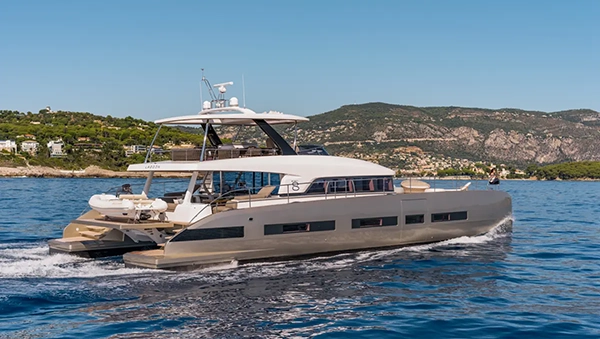


A weighty question!
| 28 August 2011 | Posted by Alex from Lagoon under Technical world |
One of the important characteristics of a catamaran is its weight (just like for a boxer!). According to naval architects this measure is an indicator of the performance capacities with the well known weight / sail area ratio. For sure, I am not a naval architect but I can submit you some ideas about this concept!
First, in boating you do not use the term weight but “displacement”. Why? Because this term comes from the famous physicist: Archimedes. Legend says that “Archimedes discovered the principle of displacement while stepping into a full bath. He realized that the water displaced when he entered his bathtub ran over in equal volume as the submerged part of his body”. The same goes for a boat entering the water. The Archimedes’ legend also tells us that he was so happy with this revelation that he jumped out of the bath, and ran naked into the street saying, “Eureka!” “Eureka!” (which means “’I found it!”).
So, coming back to our business regarding weight. When you do not know a lot about boats you can feel a bit dizzy when someone talks about boat displacement. In fact there are 2 radically different definitions: light displacement and max loaded displacement. These terms are defined by ISO norms which are used by the European Economic Community regulations. A builder like Lagoon has to respect these norms and others like boat design EEC classification.
According the ISO 12217and ISO 866 norms (boring to read!), the light displacement refers to:
- all structural elements
- all the comfort equipment included in the standard version of the boat (as mattresses, cushions, cockpit table),
- the heaviest engines available,
- standard batteries,
- electronics,
- standard deck equipment (ladder, winches, anchors chain and anchor, mast, boom, standard sails, sheets, halyards…).
According to norm ISO 14946, the max loaded displacement refers to the light displacement with in addition:
- the maximum number of persons that the boat can accept (75 kg each),
- all the extra equipment,
- the basic personal equipment,
- provisioning,
- all tanks full (fuel, water and grey tanks),
- Liferaft.
Now, when you read the specifications of a boat on a brochure you should ask yourself:
- what type of displacement is the boatbuilder talking about?
- is this displacement definition in compliance with ISO norms?
Indeed some builders do not specify if the displacement complies with ISO norms. The answer matters if you want to compare 2 boats because if you have the right info so you can evaluate with precision the payload of the catamaran and the equipment that you can take with you.
For example here is some equipment weight which can totally change the displacement of your cat (the example here is for a 40’ catamaran) :
- davits and electrical winch : 60 kg
- watermaker : 60 kg
- ice maker : 30 kg
- microwave oven : 20 kg
- AC : 142 kg
- Washing machine : 52 kg
- 2 additional batteries : 85 kg
- Genset : 300 kg
At the end with just this equipment you have an extra weight of : 749 kg. And this does not include the dinghy, the outboard engine or the extra sails!
So to avoid being misled, ask for the CE displacement and to save weight and/or money, check the extras list!
-
Mathieu
-
http://www.cmid.dk Lars Oudrup
-
http://linocat.blogspot.com Michael
-
Meir Riba